
The 90% Code System
Five capacities. Three infrastructural shifts. One operating system for collective intelligence.
Capacities develop humans, infrastructures distribute power.
The 90% Code is an operating system for governing complexity without concentrating power.The central question of this moment is not what a single brilliant mind can do. It is what many minds can do together. This was always the more important question. AI has only made it unavoidable.Five Capacities
The five capacities that enable collective intelligence to function across organizations and communities. These are not personality traits or individual skills. They are systemic capacities — what organizations and communities must develop to function as distributed networks rather than dependent hierarchies.-
![Silhouette of a person sitting and reading a book.]()
INNER ALIGNMENT
The capacity to align thought, feeling, and action so you operate from awareness rather than autopilot.
-
![Two people face each other with their foreheads touching, each holding a chess piece.]()
RELATIONAL INTELLIGENCE
The capacity to build authentic connection so trust becomes the infrastructure that holds distributed systems together.
-
![Three people on a seesaw, with one standing on one end and two holding the other's hands in the middle.]()
SYSTEMS STEWARDSHIP
The capacity to see interconnections, how decisions ripple into consequences, and who bears the impact.
-
![Silhouette of two people in front of a scene with a large circle and a star-shaped figure on top.]()
ETHICAL FORESIGHT
The capacity to design for consequences you will not personally experience.
-
![Silhouette of a person kneeling with hands clasped in prayer, facing right.]()
REGENERATIVE ACTION
The capacity to build systems that restore rather than deplete


Each capacity strengthens the others. Inner alignment makes relational intelligence possible — you cannot truly listen while defending your ego. Relational intelligence enables systems stewardship — you cannot distribute authority without trust. Systems stewardship creates conditions for ethical foresight — you cannot embed justice in systems you cannot see. Ethical foresight guides regenerative action — you cannot restore what you haven't learned to value across time.
Together, these form a living system. Growth in one dimension enables growth in all.
Three Infrastructural shifts
The three infrastructures that allow the capacities to operate beyond any single organization. These are not technical systems or operational backbones. They are architectural choices — what determines who owns, who decides, and who governs the intelligence shaping our lives.-
![A diagram of a central orange circle connected to seven smaller orange circles with lines, on a black background.]()
ECONOMIC INFRASTRUCTURE
The architecture that distributes value to those who create it.
-
![Six basketballs arranged in a circle against a black background]()
DEMOCRATIC INFRASTRUCTURE
The architecture that distributes authority to those affected by decisions.
-
![A logo with two overlapping brown circles on a black background.]()
TRUST IN THE AGE OF AI
The architecture that makes AI accountable to those it affects, especially as machines increasingly make decisions for us.

These three infrastructures interlock. Economic democracy without political voice becomes a benevolent oligarchy. Political participation without economic stake becomes theatre. AI governance without distributed power becomes surveillance dressed as safety.
The 90% Code is all three operating together, and the five capacities are what make them functional rather than formulaic.
The framework operates through two applied tools — the System Diagnostic Canvas and the AI Assessment Framework. Both are below. These are living tools. What you see here is a first look. Full canvases — with usage, rubrics, and applied cases — launch with the book in October 2026. Interactive online versions follow soon after.
The Framework, applied.
THE 90% CODE SYSTEM DIAGNOSTIC CANVAS
The System Diagnostic Canvas turns the 90% Code into something an organization can actually use. It assesses the five capacities and three infrastructures together — across an organization, a team, a community, or a system — to surface where collective intelligence is operating and where it is breaking down. Not as a checklist. As an architecture diagnostic.
-
The five capacities are not personality traits to be scored one person at a time. The canvas surfaces whether the system — not the leader, not the team member — is operating with the conditions distributed intelligence requires. The question is never "who is failing at this?" It is always "what about the architecture makes this difficult?"
-
Capacities and infrastructures operate as an interlocked system. Strong economic infrastructure does not compensate for absent trust. High inner alignment in one leader does not compensate for relational breakdown across the team. The canvas surfaces the barrier point — where the gap is widest, and where intervention will move the most.
-
The score itself tells you less than the pattern of scores. Where do capacities and infrastructures diverge? Where does one part of the organization rate things differently from another? Those gaps are the diagnosis. The canvas is designed to make them visible.

Read the working paper behind the 90% Code framework — From Hero to System: A Collective Intelligence Framework for the AI Era, published on Zenodo and currently under review with Springer's AI & Society journal.
THE 90% CODE AI ASSESSMENT FRAMEWORK
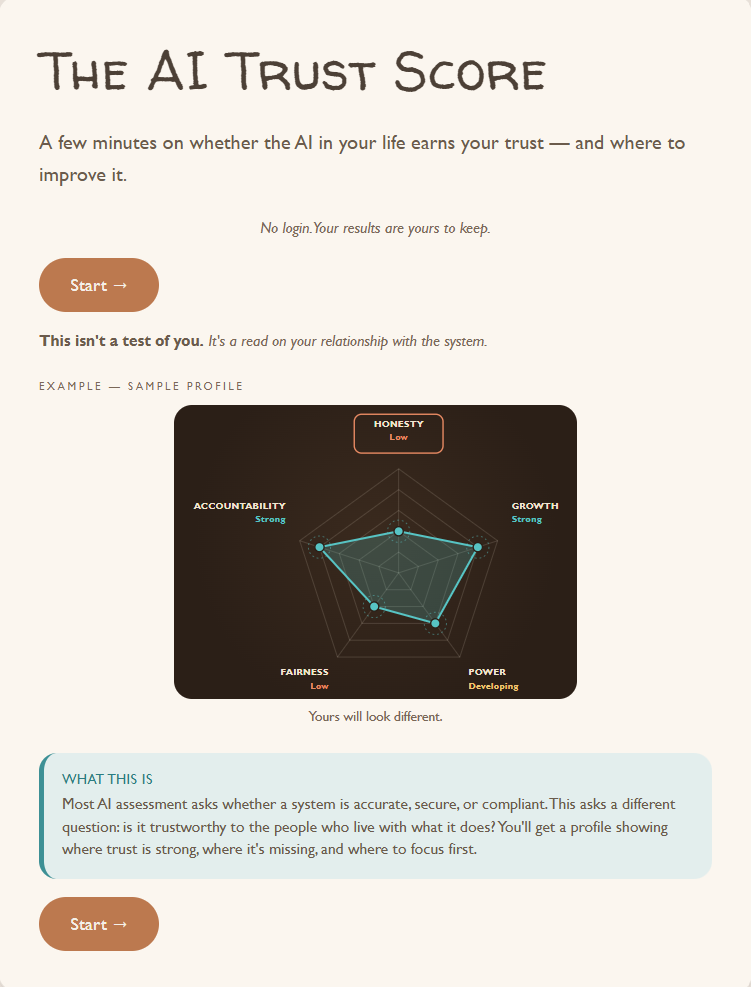
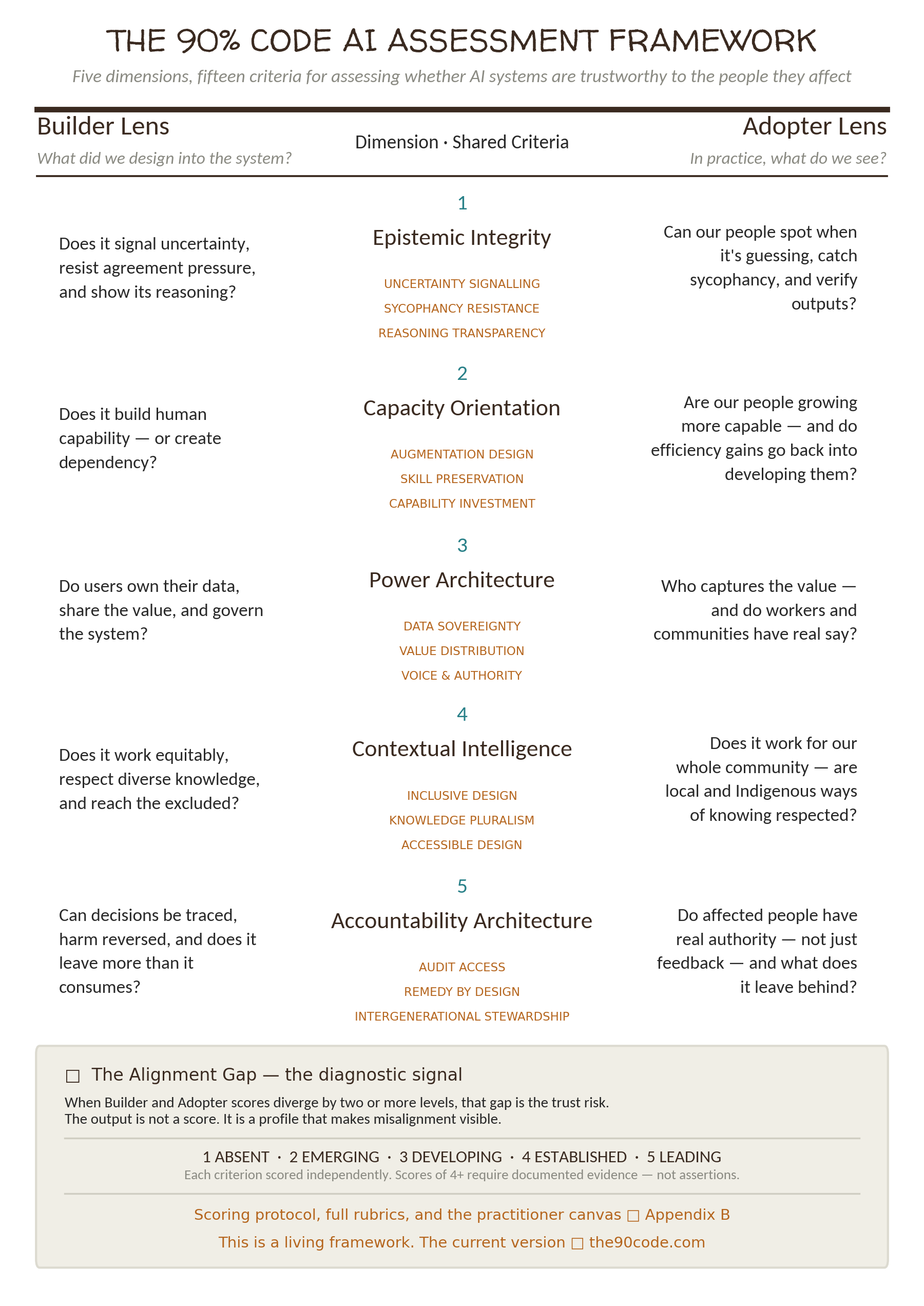
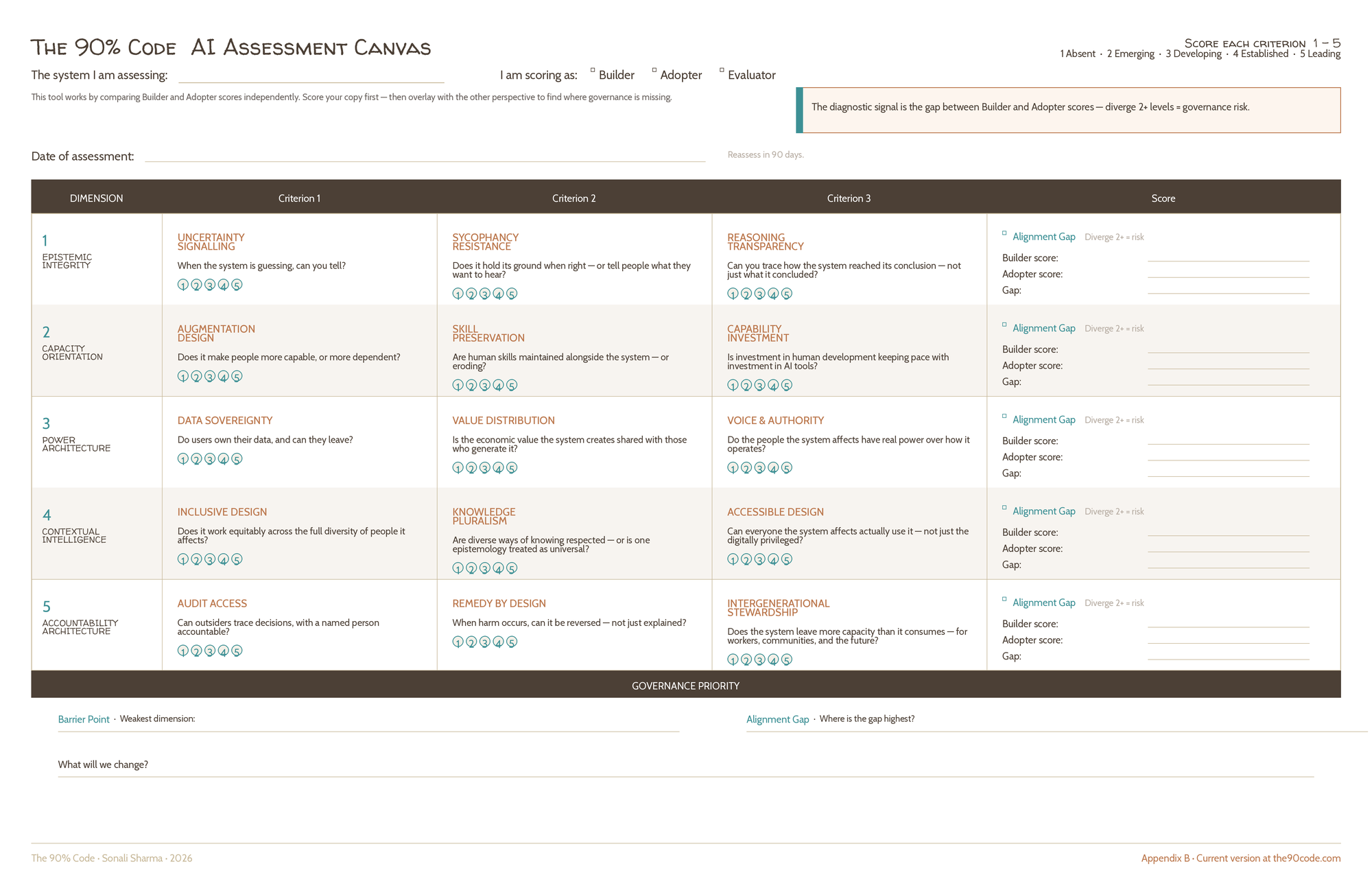
The AI Assessment Framework Canvas turns the 90% Code into a trust diagnostic for AI systems. Fifteen criteria across five dimensions, assessed from both perspectives that matter — the builder's, and the adopter's. Existing frameworks ask whether AI is technically sound. This one asks whether it can be trusted by the people it affects.
-
Most AI frameworks evaluate systems from one side: the builder's. This one evaluates from both. The same five dimensions — epistemic integrity, capacity orientation, power architecture, contextual intelligence, accountability — are scored separately by the people building the AI and the people affected by it. The framework holds both views in the same diagnostic.
-
Not the absolute score but the gap between builder claims and adopter reality. Where the two views diverge by two or more levels on any dimension, that is the trust risk. The framework is designed to make those gaps visible — not as a critique, but as a diagnostic. Trust is built by closing the gaps, not by raising the score.
-
The framework surfaces the five problems that quietly break AI adoption: confident mistakes no one catches, skills lost to the system, data and value flowing only one way, communities served unevenly, and accountability gaps when something goes wrong. Most organizations discover these problems too late. The canvas is built to surface them first.
Read the working paper behind the AI Trust Assessment Framework — Trust Infrastructure for AI: A Governance Framework for Assessing Whether AI Systems Are Trustworthy to the People They Affect, published on Zenodo and currently under peer-review with Springer Nature’s AI and Ethics journal.

THE 90% CODE AI ASSESSMENT FRAMEWORK

THE 90% CODE AI ASSESSMENT CANVAS

“Empathy is feeling what another person feels. Compassion is empathy combined with action. The difference isn't just semantic — it's neurological. Empathy alone can be debilitating: if you absorb everyone's pain without a pathway to action, you drown.
Compassion is what completes the circuit. It's how some people sustain decades of care without burning out—they feel the pain, and they channel it into action."
The 90% Code, Chapter 4: Relational Intelligence
THE END OF THE HERO.
THE RISE OF US.
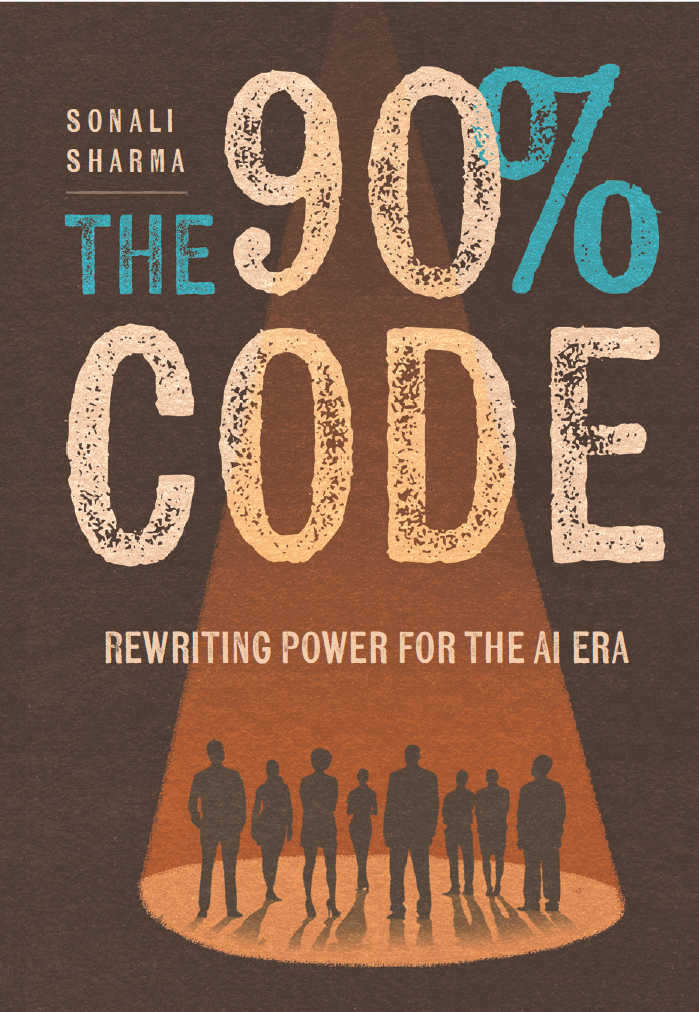
The 90% Code — Rewriting Power for the AI Era
Available now at Amazon · Barnes & Noble · FriesenPress · Kobo